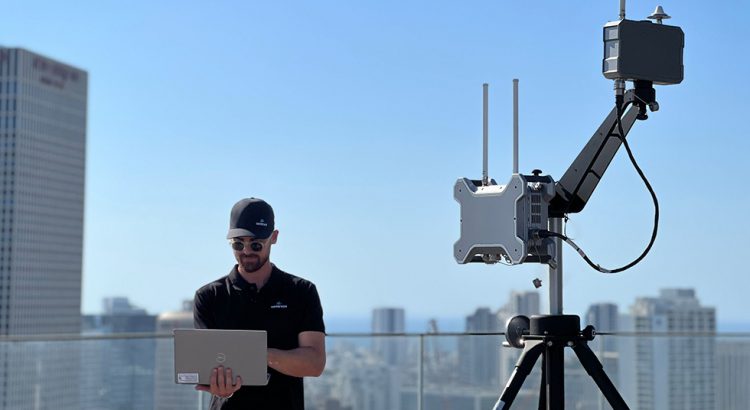
Sentrycs recently participated in the DHS (Department of Homeland Security) anti-swarm tests. During a series of rigorous tests last month in Oklahoma, Sentrycs successfully demonstrated its ability to simultaneously detect and track multiple drones, operating at diverse ranges, altitudes, and speeds. It completed multiple scenarios:
- Individual and multiple drones flying in various formations up to 2.5 km (1.6 miles) away and 500 meters (1,640 ft) high
- Safe drone mitigation; distinguishing authorized from unauthorized drones; tracking DJI, Autel, and Parrot drones simultaneously; tracking and mitigating the only 4G-enabled commercial drone
- Outside the planned test and demo, several other drones were detected and tracked flying 12km to 25km away
Sentrycs’ technology is based on Protocol Analytics, which enables safe and dependable detection, tracking, and identification of commercial, DIY and manipulated drones, ensuring zero false alarms and no disruption to other communication signals. Additionally, it can facilitate the secure takeover of unauthorized drones, safely guiding them to a controlled landing or directing them back to their point of origin, while leaving authorized drones unaffected.
As was demonstrated in the tests, the system is not sensitive to the proximity of the drones to each other, the altitude they are flying at, or their speed.
Yoav Zaltzman, CEO of Sentrycs highlighted that, “Sentrycs’ showcase at the recent DHS testing scenario in Oklahoma is a testament to the technological breakthroughs we keep pushing for and our relentless drive for excellence. The consistent and reliable results our system delivered underscore the transformative potential of our technology in the face of drone threats in general, and drone swarms in particular.”