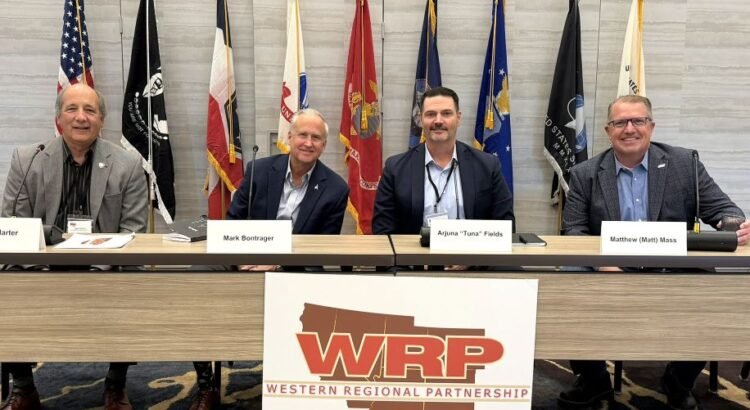
Photo – Aviation panel members from left are, Gary Harter, Mark Bontrager, Arjuna “Tuna” Fields and Matthew Maass.
Senior leaders from state, federal and Tribal agencies gathered May 28-29 for the 2026 Western Regional Partnership (WRP) Principals’ Meeting in Deer Valley, Utah.
Before the meeting officially kicked-off, separate meetings were held among Department of War, state and Department of the Interior members to share updates and coordinate on regional challenges and opportunities.
Throughout the meeting, Principals were updated on accomplishments detailed in the 2026 report on Enhancing Resilience to Avoid Cascading Disaster. The bulk of the meeting was focused on the WRP’s Deep-Dives through plenary sessions including one on Aviation/Airspace Needs.
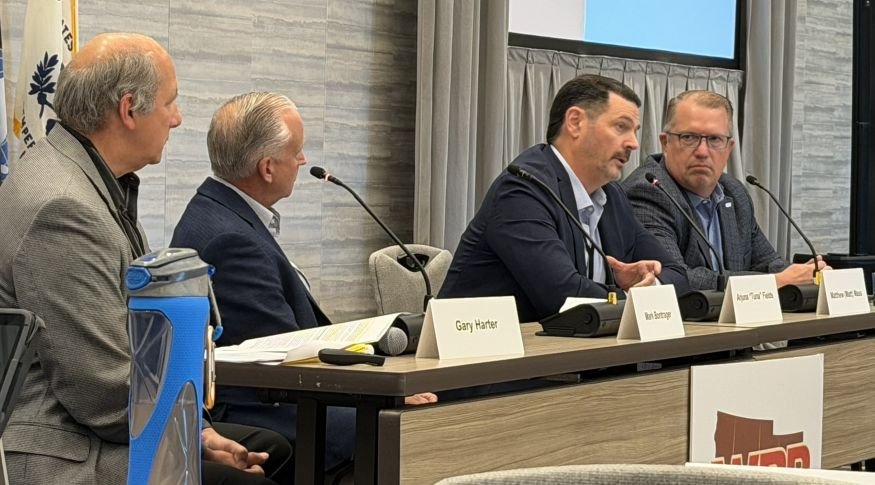
The WRP Aviation/Airspace Needs Plenary panel, consisting of Mark Bontrager, Arjuna “Tuna” Fields and Matthew (Matt) Maass, focused on how quickly the aviation environment in the WRP Region is evolving and what that means for resiliency, safety, and coordination. Gary Harter, Commissioner, Utah Department of Veterans and Military Affairs, the panel moderator, stated, “the WRP Airspace Deep-Dive outcomes provided a clearer, shared picture of what resilient airspace really requires: better data sharing, stronger coordination, and a more deliberate way to integrate new entrants without disrupting military or civilian operations.” Panelists emphasized that the WRP Region is especially complex, as it includes some of the nation’s busiest airports, major military training ranges, and commercial spaceports with rapidly expanding demand from drones, advanced air mobility, and space launch activity. Across all of those uses, the core challenge is how to modernize infrastructure, improve data sharing, and integrate new entrants without degrading existing operations.
Mark Bontrager, System Delta 80 Operations Integration Technical Director, Cape Canaveral Space Force Station, Florida, highlighted the growing national importance of space access, noting that space is essential not only to national security but to communications, navigation, weather, and everyday economic activity. He stressed that the Space Force is deploying resources to enhance the resiliency and efficiency of our launch ranges and spaceports as national security, commercial, and civil launch demands increase. Mr. Bontrager stated, “Participating in forums like the Western Regional Partnership allows us to share our expertise regarding airspace and other aviation requirements that are unique to space launch. System Delta 80 is dedicated to fostering resilient launch architecture that supports the Department of War while empowering our commercial partners. It is exactly this kind of cross-sector synergy and collaboration that will secure our capabilities today and enable innovation.”
Arjuna “Tuna” Fields, Senior Advisor AAM & UAS Integration/Air Traffic Organization /Strategy, Federal Aviation Administration (FAA), focused on the FAA’s modernization efforts, including air traffic control upgrades, dynamic airspace management, AI-enabled planning, and regulatory changes intended to support drones, advanced air mobility, and commercial space. He underscored that the WRP Region is less a problem set than an opportunity-rich proving ground because of its scale, complexity, and concentration of aviation and defense activity. Mr. Fields offered “The biggest takeaway is that no single agency or stakeholder can solve these challenges alone; progress depends on sustained collaboration, shared information, and a willingness to modernize together across every level of government and industry. The Western region is not just a concentration of challenges, it is a concentration of opportunity, because the scale, complexity, and mission demands of the variety users within the airspace, make it the right place to help shape the future of a more dynamic and integrated airspace.”
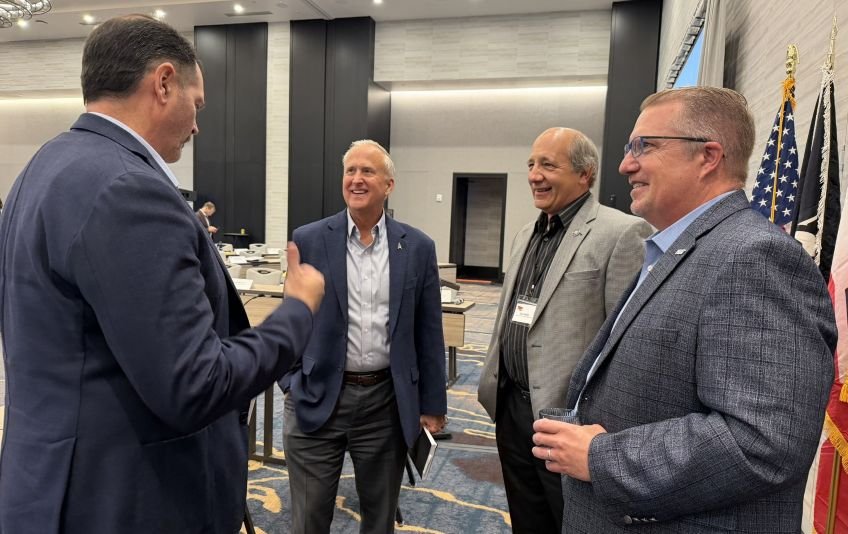
Matthew (Matt) Maass, Director, Utah Department of Transportation (UDOT) Division of Aeronautics, brought the state and implementation perspective, describing Utah’s efforts to prepare for future spaceport opportunities and to lead through the FAA’s EIPP/UFLY West work on advanced air mobility. He emphasized practical use cases such as package delivery, medical support, firefighting and, eventually passenger movement, while also noting the need for communities to prepare for supporting infrastructure, workforce, and policy changes. Mr. Maass noted, “The opportunity in front of us is to build on the aviation infrastructure we already have, use real-world testing to shape smart policy, and help communities prepare now for the technologies that are about to move from concept into daily operations. We are preparing for a future where advanced air mobility supports package delivery, medical response, firefighting, and eventually passenger movement, but success will depend on doing the groundwork now with testing, planning, and local coordination.”
The panel discussion reinforced that successful integration will require close collaboration among federal, state, tribal, military, and industry partners, especially on issues like counter-UAS authorities, airspace modernization, emergency response, and infrastructure readiness. Overall, the panel concluded that while the pace of innovation is creating real policy and operational challenges, the WRP is well positioned to help shape solutions through continued coordination and shared learning.
After the meeting concluded, there was an optional tour of Hill Air Force Base (AFB) that highlighted their mission and importance to national security.