Have you ever wondered how birds can soar gracefully through the air for long periods without flapping their wings? The answer lies in temperature, wind patterns and the way air moves up and down in the atmosphere. A coalition that includes researchers from The University of Texas at El Paso are using these insights from bird flight to develop uncrewed aircraft systems (UAS), or drone technology, that can save energy and fly more efficiently.
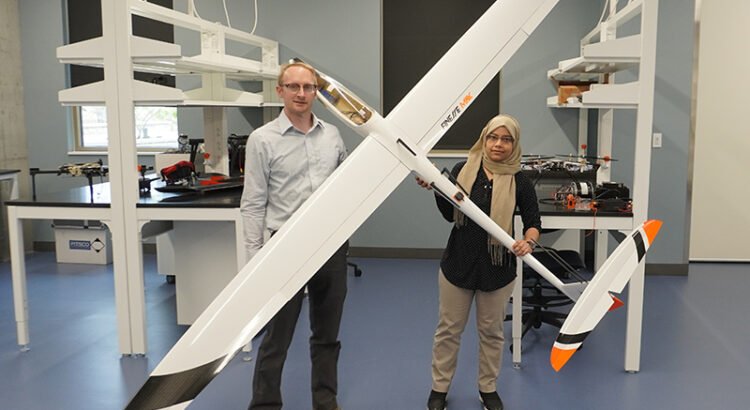
Appropriately-named researcher John Bird, Ph.D., an assistant professor of aerospace and mechanical engineering at UTEP and expert in the science of soaring, is a member of Albatross, a project that recently received a multimillion grant from the Defense Advanced Research Projects Agency (DARPA).
Bird explained that DARPA often funds research that pushes the frontiers of existing knowledge, leading to the development of technologies like self-driving cars and robots that can be used in disaster relief efforts.
“We are excited for the opportunity to explore the science of autonomous soaring and develop technology which could dramatically reduce the amount of energy UAS require,” he said.
Bird explained that as the Sun warms the surface of the Earth, heat is transferred into the air and the warm air rises – think of a hot air ballon. If an object, like a bird, glides down toward Earth’s surface more slowly than the air is rising, the air holds it aloft. By navigating between pockets of air that are descending to pockets of air that are rising, birds can get where they need to go without flapping their wings and using up valuable energy, he said.
Bird said that the Albatross project is seeking to translate birds’ intuitive understanding of these air patterns into a tool that humans could apply to drones, especially those flying longer distances.
“These air patterns are small, short-lived and random, and they’re not going to be picked up by a weather model,” he said. “So how can you incorporate all of these unknowns — including potential energy savings — into a reliable flight plan for an aircraft? That’s the question we are trying to answer.”
Co-investigator Afroza Shirin, Ph.D., assistant professor of aerospace and mechanical engineering, explained that autonomous soaring is not a new idea. However, its potential application to uncrewed aircraft flying long distances would be groundbreaking and could result in substantial energy savings by using wind, a natural source of energy.
She said, “Like birds gliding on rising air, autonomous soaring enables uncrewed aircraft to extract maximum soaring energy from the wind, reducing onboard power use and extending their flight range.”
Albatross includes researchers from Mississippi State University and Embry-Riddle Aeronautical University. The project is named after a large seabird that can mostly be found near the Southern Antarctic Ocean and North Pacific Ocean.
“Albatross are terrible at flapping their wings,” Bird joked. “Hence the need to find another way to fly.”