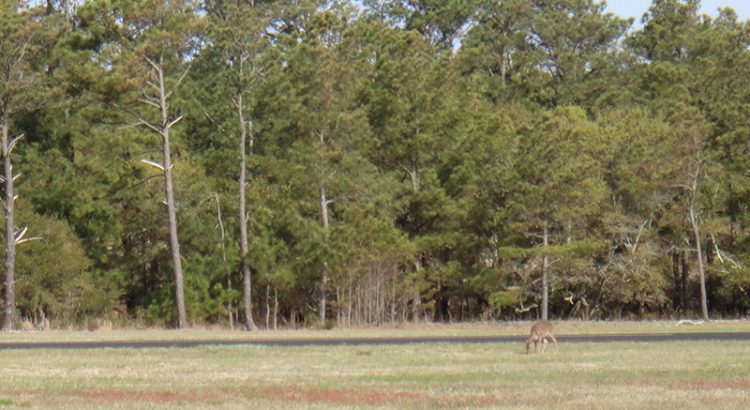
Photo above – A deer grazes just feet from the runway at First Flight Airport in Kill Devil Hills.
The N.C. Department of Transportation’s Division of Aviation is helping host a series of wildlife hazard trainings to increase safety at North Carolina’s public airports.
Wildlife incursions on airfields is one of the top dangers to aviators statewide, whether at a small rural airfield or a major international airport.
Five standard and two advanced trainings will be offered in 2019. Much of the advanced training will be tailored to individuals that handle wildlife control at their airports daily. This training will include standard topics to meet FAA Part 139 airport certification, an on-site visit to learn how to properly survey the airfield, identify what attracts animals and record data, demonstrations on multiple types of harassment devices and demonstrations on trapping techniques for birds and mammals. The scheduled training dates are:
Smith Reynolds Airport (INT) – Feb. 6
Coastal Carolina Regional Airport (EWN) – April 10 (Advanced)
Asheville Regional Airport (AVL) – June 12
Charlotte Monroe Executive Airport (EQY) – Aug. 7
Pitt-Greenville Airport (PGV) – Sept. 18
Hickory Regional Airport (HKY) – Oct. 9 (Advanced)
Raleigh Executive Jetport (TTA) – Nov. 6
The standard trainings will also cover the Wildlife Hazard Assessment and Wildlife Hazard Management Plan Process, record keeping and communications, safety issues with equipment and procedures, rules, regulations, legal reminders and wildlife permitting.
The training is open to personnel at North Carolina airports responsible for managing wildlife hazards to aviation. The training is free. Trainings typically run all day, with lunch either provided by the host airport or on your own at local restaurants. Seating is limited, so please register early. For more information or to sign up, contact Jimmy Capps at (919) 210-9428 or james.e.capps@aphis.usda.gov.