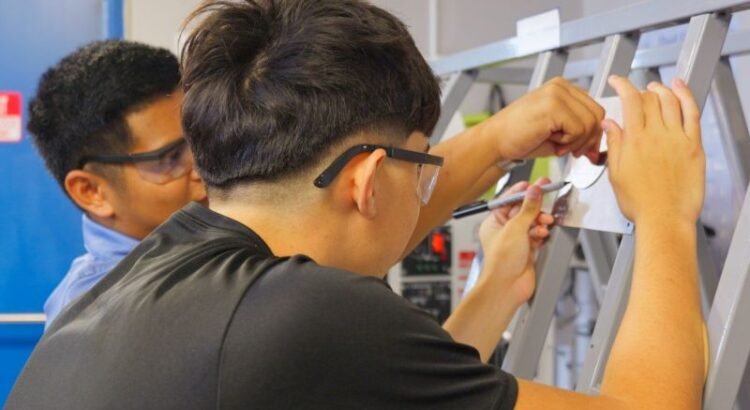
A cohort of ten students from Campbell, Kapolei, and Waipahu high schools is piloting the state’s first aviation maintenance technology program in collaboration with the Pearl Harbor Aviation Museum (PHAM).
The program provides early-career training starting a student’s junior year. The goal is to prepare students for Federal Aviation Administration (FAA) certification, enabling them to earn a living wage immediately upon graduation.
“As an island state, we rely heavily on aviation and maritime, so we wanted to make sure that we were building those pipelines,” said Wanelle Kaneshiro-Erdmann, director of the Workforce Development Branch for the Hawaiʻi State Department of Education.
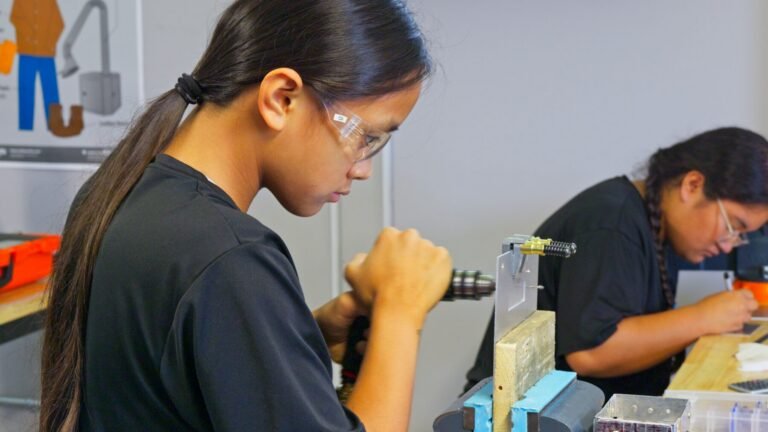
PHAM worked with the Western Maricopa Education Center to offer students a two-year, 1,900-hour program in the maintenance and repair of aircraft mechanical systems, including jet engines, hydraulics, and propellers.
Pearl Harbor Aviation Museum Director of Education Greg Farris said that there are upcoming shortages for aviator airframe and powerplant mechanics.
“By having a program like this, it sets high school students up to be able to graduate and get their airframe and powerplant certification upon graduation. That launches them directly into a career path with companies such as Hawaiian-Alaska (Airlines),” he explained. “Being able to make $85,000 a year starting is an incredible opportunity for a high school student.”
According to the U.S. Bureau of Labor Statistics, employment for aircraft mechanics and service technicians is projected to grow significantly. Graduates will enter a high-demand market driven by a retiring workforce and the rapidly expanding air and space industries.
Kealana Naluai, a student from Kapolei High School, said that she wasn’t really that big into flying because of a fear of heights.
“But I do like the engineering and the mechanics behind everything because it’s just amazing how we were able to get such big, metal, heavy machines into the sky using just engineering and physics. That’s why I’m so interested in this,” she said.
Students receive a blend of classroom and hands-on shop instruction from FAA-approved instructors in an FAA-approved hangar. After successful completion, students can test for FAA Airframe and Powerplant (A&P) certification. The hybrid learning model requires students to attend class at the training hangar four days a week and report to their home school on Fridays.
Naluai remarked, “It gives you such a good opportunity to further your education and your career path. You’re already getting a head start compared to other kids who have to graduate high school first.”
Upon graduation and FAA certification, these students are positioned for direct entry into the aviation industry, helping to bridge a critical workforce gap, earning approximately $40 an hour.
Devon Allen Araki, a junior from James Campbell High School, said, “I wanted to do engineering, but I didn’t know where to go. And going into this pathway helped me get a direct path. And now I’m fully committed to this.”