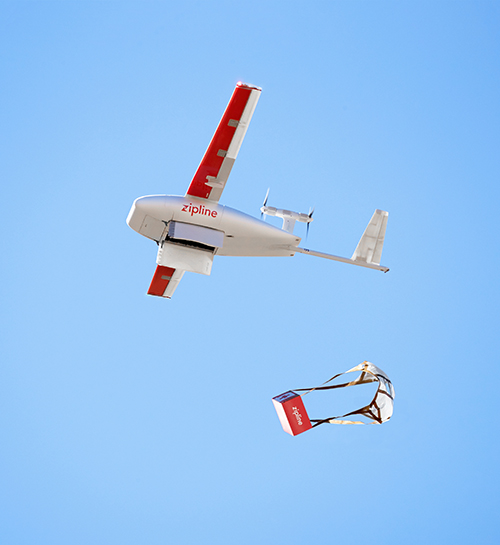
The FAA authorized Zipline International, Inc., to deliver commercial packages around Salt Lake City and Bentonville, Arkansas, using drones that fly beyond the operator’s visual line of sight. Zipline is an FAA-certificated Part 135 operator and will use its Sparrow drone to release the payload via parachute. Data collected from these operations will inform the FAA’s ongoing policy and rulemaking activities.
The FAA is focused on developing standard rules to make BVLOS operations routine, scalable and economically viable. The agency chartered the Beyond Visual Line of Sight Aviation Rulemaking Committee on June 9, 2021, to provide safety recommendations to the FAA. We are reviewing their final report.
The FAA’s long-term goal is to safely integrate drones into the National Airspace System rather than set aside separate airspace exclusively for drones. This approach is consistent with the FAA Modernization and Reform Act of 2012 and the FAA Extension, Safety, and Security Act of 2016. The 2016 Act directed the FAA, in conjunction with NASA, to continue developing a plan for Unmanned Aircraft System Traffic Management (UTM), which will assist in integration efforts.