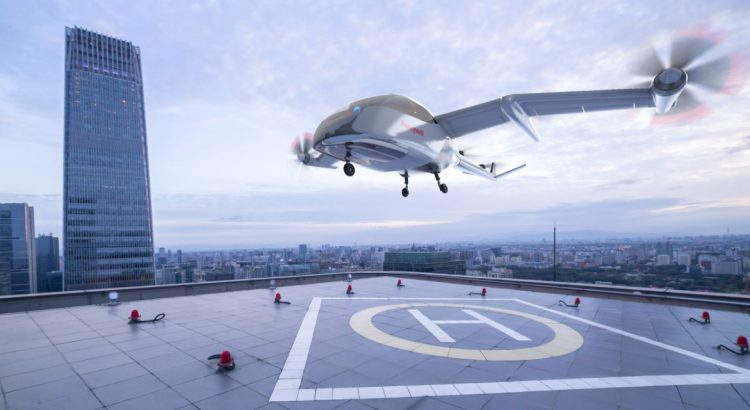
Honeywell has formed a new business unit dedicated to the growing Unmanned Aerial Systems and Urban Air Mobility (UAM) industries. The Unmanned Aerial Systems (UAS) business unit will continue Honeywell’s momentum and leadership in these emerging markets, utilizing Honeywell’s technology, software, services and certification expertise to meet customers’ needs in these markets.
“Urban Air Mobility and Unmanned Aerial Systems will play an increasing role in the future of aerospace, with potential applications in all-electric urban air taxi vehicles, hybrid-electric unmanned cargo drones, optionally piloted airplanes, delivery drones and everything in between,” said Mike Madsen, president and CEO, Honeywell Aerospace. “Honeywell has already contributed many technological advancements to these markets, and is well positioned to continue growing our portfolio to meet customer needs and help shape the future of autonomous aviation and urban transport.”
Equipped with its own engineering and sales resources, the UAS business unit will develop new products and services uniquely required for these markets. It will also act as a systems integrator for all Honeywell products and services that could be used in this industry. These offerings include aircraft systems such as avionics, electric and hybrid-electric propulsion and thermal management, flight services such as unmanned air traffic management, and ground operations services such as predictive aircraft maintenance analytics. Beyond technology development, this business will be a single point of contact for innovative aircraft designers or operators to easily do business with Honeywell.
“We’re seeing the dawn of a new era in aviation, and Honeywell is at the forefront,” said Stéphane Fymat, vice president and general manager of the newly formed business. “By forming this new organization, we will be able to harness the power of our engineering resources and know-how to transform urban air taxis, drone delivery of parcels and all forms of autonomous flight from a future vision into an everyday reality.”
The new organization will further expand Honeywell’s growing portfolio of UAM solutions, and is heavily focused on software development, driving rapid development and testing of new products like:
- A “fly-by-wire” autopilot system that automatically ensures aircraft stability even if the pilot is “hands off” for extended periods of time
- Detect-and-avoid algorithms that automatically fly an aircraft around oncoming traffic
- Artificial intelligence software that tracks landing zones for precise vertical landings every time
Honeywell is a leading provider of systems for urban air taxi and cargo vehicles as well as other types of aircraft, including integrated avionics, flight controls, electric and hybrid-electric propulsion, actuation, and cabin environmental control systems. The company collaborates actively with other industry leaders such as Pipistrel, Vertical Aerospace, Volocopter and Jaunt Air Mobility. Beyond UAM, discussions are also underway with customers pursuing other unmanned flight operations, such as drone package delivery.
To learn more about Honeywell’s advanced solutions for UAM platforms, visit the UAM page on the Honeywell Aerospace website.