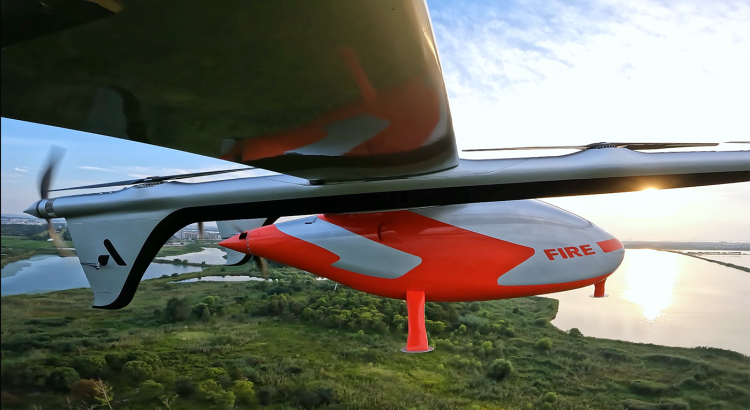
Global eVTOL pioneer AutoFlight has announced the launch of a high-payload firefighting program and released a fully functional prototype.
With a maximum takeoff weight of two metric tons (MTOW), the firefighting model is designed to lift a 400kg payload over a distance of up to 200km and can reach speeds in excess of 200km/h.
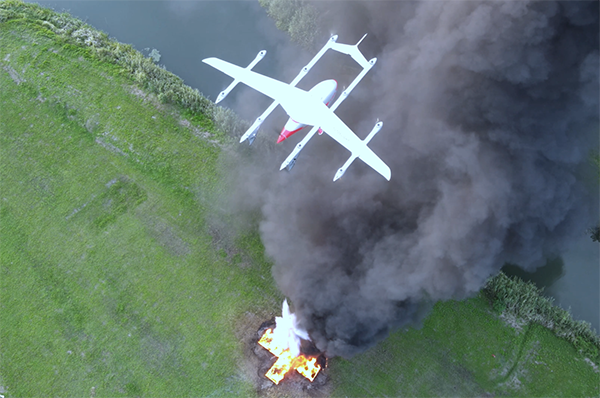
It can transport four high-performance fire-extinguishing canisters, each weighing 100kg, with the capacity to extinguish fires covering up to 200 sq/m individually. This means that in a single payload, the four canisters can collectively extinguish fires spanning up to 800 sq/m.
World’s First eVTOL Formation Flight by AutoFlight; See Video
The firefighting model is based on the CarryAll, AutoFlight’s cargo eVTOL, for which Civil Aviation Administration of China (CAAC) certification is expected by early 2024.
Kellen Xie, Senior Vice President of Global Sales & Business Development at AutoFlight said:
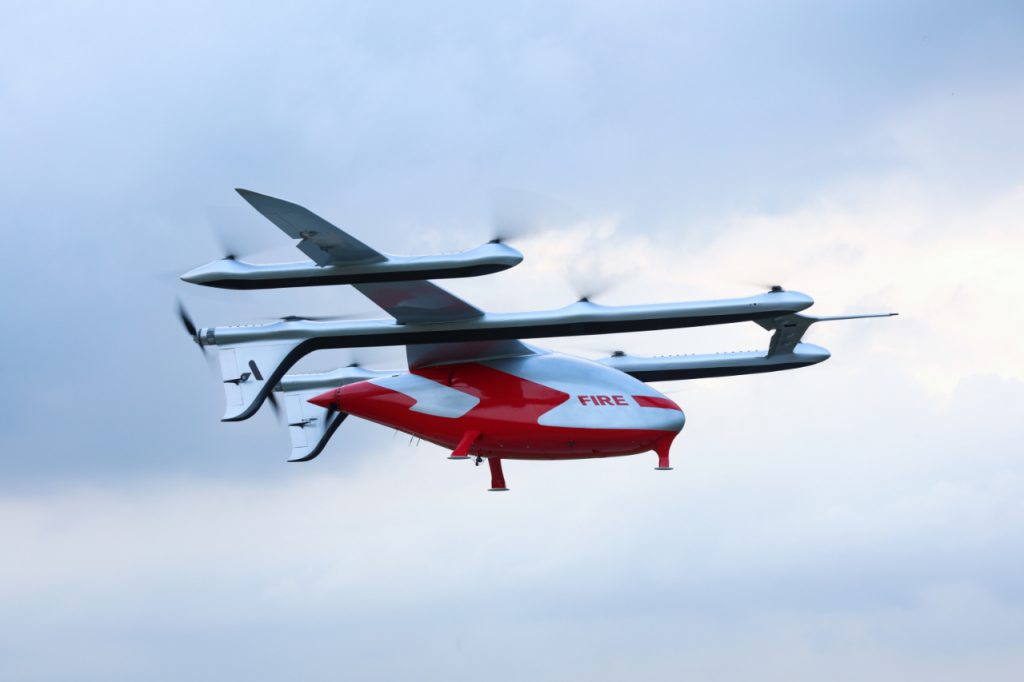
“Compared to existing fire-fighting Unmanned Aerial Vehicles available in the market, AutoFlight’s prototype has achieved significant breakthroughs in terms of load capacity, flight duration, coverage, flight efficiency and firefighting effectiveness. The initial demonstrations with potential customers received very encouraging feedback. We will now enter discussions with clients and development partners to evolve the prototype into product, including ground station and supporting systems.”
World’s Longest eVTOL Flight – 250.3KM – AutoFlight; See Video
Mr. Xie added that units can now be sold for joint development by firefighting organizations for operation in 2024. Interested parties should contact sales.eu@autoflight.com (Europe/MENA) or sales@autoflight.com (Asia).