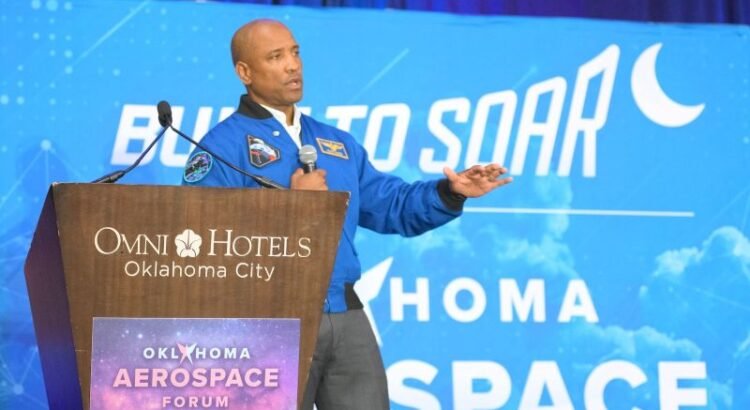
More than 400 aerospace executives, military leaders, policymakers, researchers and students gathered yesterday at the ninth annual Oklahoma Aerospace Forum, where NASA astronaut and U.S. Navy Capt. Victor J. Glover, Jr., urged attendees to lean into the many pathways driving aerospace and deep-space innovation. Organized by Jones Strategies, this year’s forum focused on strengthening collaboration among the public, private, research and academic sectors while accelerating Oklahoma’s leadership in space, defense and autonomous aviation.
Capt. Glover piloted the historic Artemis II lunar flyby mission in April 2026 and was introduced at the Forum by former NASA Administrator Jim Bridenstine, now CEO of Quantum Space, a space defense and orbital mobility company. During his visit, he met with employees of Frontier Electronic Systems, based in Stillwater, to thank them for developing and manufacturing sophisticated hardware that are critical elements to the Orion Capsule and Artemis missions.
“There is a seat for everyone at the table for aerospace and deep space innovation,” said Capt. Glover. “Whether you have a high school degree, attend career technology schools or universities, there is a path to be involved in the aerospace industry.” He stated that the aerospace industry needs skilled trade professionals, such as welders and electricians, who build and maintain space platforms. He recognized Oklahoma’s career technology centers and universities for their close collaboration with private sector aerospace companies to tailor research, cybersecurity and academic programs toward advancing the aerospace industry.
Capt. Glover also highlighted the nation’s strong demand for air traffic controllers, noting that the Federal Aviation Administration Academy, the nation’s training center for federal air traffic controllers, is located at the Mike Monroney Aeronautical Center in Oklahoma City.
“Oklahoma is a heartland hub for aerospace innovation. The state has built an ecosystem where innovation moves rapidly from initial testing to commercial application. Whether developing autonomous flight capabilities or supporting deep space infrastructure, Oklahoma is an essential hub for national security and commercial space growth,” said Bridenstine.
Throughout the day, panel discussions addressed critical industry drivers, including defense sustainment at Tinker Air Force Base, uncrewed aerial systems (UAS), and Advanced Air Mobility (AAM). Panelists examined infrastructure needs, regulatory pathways, and how Oklahoma’s energy sector expertise in high-pressure systems and fluid dynamics can directly support next-generation space testing and propulsion.
Aerospace initiatives and companies featured at the Forum include Oklahoma ACES (Aerospace Commerce Economic Services), Quantum Space, the Artemis Group, and Frontier Electronic Systems. Discussions also highlighted educational pathways and workforce capacity through programs such as LaunchOK, which converts redirected tax dollars into non-competitive grants for school-wide STEM and aerospace programs.
“The purpose of the Forum is simple. Convene the leaders of every segment of Oklahoma’s aerospace community into the same room to collaborate and accelerate the growth of the aerospace industry to ensure a workforce pipeline for the next generation,” said Brenda Jones Barwick, President & CEO of Jones Strategies.