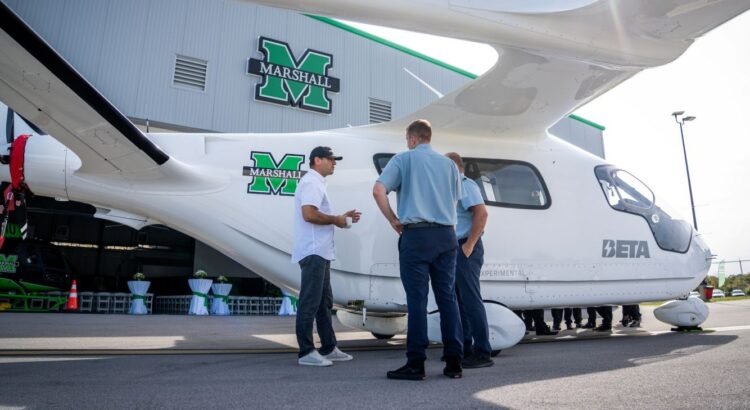
Marshall University and BETA Technologies (NYSE: BETA), an aerospace and defense company, today brought together university leaders, students and community members to experience the future of electric aviation in West Virginia. The event, hosted by Marshall and BETA at Marshall’s Bill Noe Flight School at West Virginia International Yeager Airport (CRW), celebrated the activation of BETA’s newest 320 kW Charge Cube with a ribbon cutting and the first charging session on BETA’s all-electric ALIA conventional takeoff and landing (CTOL) aircraft. The ALIA CTOL also flew a demonstration flight.
West Virginia’s demonstrated commitment to the future of aviation, paired with BETA’s investment in the state, has enabled a rapidly expanding charging network, with sites currently online at Eastern West Virginia Regional Airport (MRB) in Martinsburg, Greenbrier Valley Airport (LWB) in Lewisburg, Charleston, and soon-to-be Huntington Tri-State Airport (HTS) in Huntington, West Virginia. These charging sites, which share locations with each of Marshall’s campuses, increase connectivity for students and enable exposure to Advanced Air Mobility (AAM).
“BETA is investing in the entire ecosystem that makes electric aviation possible: the aircraft, the charging network and the people who will fly and maintain them,” said Blain Newton, chief information officer at BETA. “With our first charger now online in West Virginia, we’re connecting the state to a growing network and laying the groundwork for new possibilities in regional transportation. We imagine a future where these aircraft connect small towns to hospitals, to jobs and to each other. It’s exciting to share that progress with Marshall University and its students, who represent the next generation of aviation professionals.”
The event also strengthens the ongoing engagement between Marshall and BETA to explore how emerging aviation technologies complement the university’s existing aviation programs and create new educational and workforce development opportunities. Through its growing aviation programs and Aviation Pillar of Excellence, Marshall is preparing students for careers in a changing aerospace industry, while BETA is developing the aircraft, charging infrastructure and enabling technologies needed to support that industry’s evolution.
“This is a milestone moment for Marshall University Aviation as we look toward the future of aviation,” said Brad D. Smith, president of Marshall University. “Our aviation program is not solely about teaching students to fly; it is about preparing them to lead in one of the world’s most essential industries. The innovation this announcement brings is a testament to what can happen when Marshall brings the right people together and turns bold ideas into action. Kudos to everyone who made today’s event with BETA Technologies possible.”
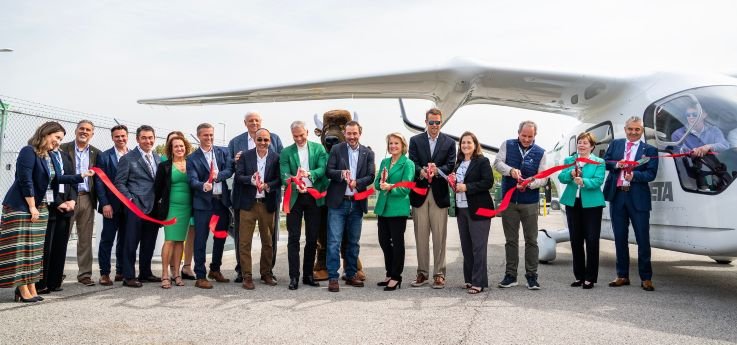
BETA flew its ALIA CTOL aircraft to Charleston for the event, which drew more than 200 attendees, including U.S. Sens. Shelley Moore Capito and Jim Justice, U.S. Rep. Carol Miller, state officials, Marshall University leaders, students and faculty from the Bill Noe Flight School and members of the local community. Attendees experienced an up-close look at BETA’s electric aircraft and charging technology, including a flight demonstration, ribbon cutting and the inaugural charging session at CRW.
“It is great to be here today in Charleston to celebrate the announcement of Marshall University’s partnership with BETA Technologies,” Sen. Capito said. “Marshall University Division of Aviation sets the standard for aviation education, and I have been proud to support them in their mission to foster high-quality aviation and talent right here in West Virginia. This collaboration will have an immense impact on the future of aviation, and I look forward to seeing the many benefits it will bring to our state.”
BETA has built its charging network with a deliberate focus on rural and underserved communities. The company has prioritized sites in regions where electric aviation can do the most to expand regional access, including small and midsize airports that have limited commercial air service today, including Charlottesville-Albemarle Airport (CHO) in Charlottesville, VA; Akron-Canton Regional Airport (CAK) in Canton, OH; and Raleigh Executive Jetport at Sanford-Lee County (TTA) in Sanford, NC. Each charge site is equipped with the infrastructure needed to support electric aviation operations at scale. Each site adds a link between communities that are often hours apart by road. BETA’s Charge Cubes are multimodal and interoperable, so the same infrastructure can serve electric aircraft and ground vehicles alike.
The BETA Charge Cube shares an airfield with Marshall University’s Bill Noe Flight School, which has trained pilots at CRW since 2021. The school offers a bachelor’s degree in professional pilot under FAA Part 141 and flies a fleet of Cirrus SR20 aircraft from CRW, Eastern West Virginia Regional Airport in Martinsburg and Greenbrier Valley Airport in Lewisburg. Marshall expects the school to enroll 350 students and produce about 50 commercial pilots a year at full operation. The university’s aviation maintenance technology program is based at Huntington Tri-State Airport, the site of BETA’s second West Virginia charger.
“Investing in this complete technology ecosystem establishes Marshall University as an early adopter and regional leader in advanced air mobility education,” said Bill Noe, chief aviation officer at Marshall University Aviation. “By embedding electric propulsion, thermal management and modern flight controls directly into our flight and maintenance programs, we are ensuring our graduates are ready to lead the aerospace industry into the future while driving economic opportunity across Appalachia.”
Marshall and BETA have engaged in ongoing discussions about the evolution of electric aviation and how emerging technologies could be incorporated into aviation education and training. The showcase provided students, faculty and university leadership with an opportunity to experience BETA’s aircraft and charging technology firsthand and engage directly with the company’s pilots and engineers.
“Marshall University has always been a place where West Virginians turn big ideas into reality, and this partnership with BETA Technologies is another perfect example. We’re taking what starts in the classroom and putting it to work in the skies by bringing revolutionary electric aviation technology, critical medical transport capabilities, and elite training directly to our students. As a proud Marshall graduate, I am all in on this effort. I believe in Marshall, I believe in our students, and I believe there is no limit to what they can accomplish when we give them the opportunity to lead,” Sen. Justice said.
“Marshall University continues to expand its aviation programs and create new opportunities for students across West Virginia,” said Congresswoman Miller. “Through its relationship with BETA Technologies, Marshall will help equip students with the hands-on training and education needed to excel in an ever-evolving aviation industry. This initiative has the potential to strengthen critical cargo and medical transportation, drive innovation and create economic development right here in Almost Heaven.”