Airports generate hundreds of billions of dollars in direct and indirect economic activity annually in the United States, supporting millions of jobs and serving as critical gateways for commerce, tourism, emergency response, and national security. For states and local communities, an airport is often the single largest economic asset they own.
Each airport plays a unique role based on its location, airspace, and surrounding economy. When managed well, an airport attracts investment, supports jobs, and generates long-term revenue. When managed poorly, it becomes a financial drag on already constrained municipal and state budgets.
The difference between those outcomes comes down to how safely, efficiently, and continuously the airport is managed—and how effectively leadership uses data to improve performance over time.
The Regulatory Reality: Compliance Is Not Optional
Airport operators and state aviation directors operate within a dense framework of FAA Orders, Advisory Circulars, and grant assurances. For any airport accepting FAA Airport Improvement Program (AIP) funding, compliance is not discretionary—it is a fiduciary obligation to the public.
Recognizing both the operational burden and opportunity for modernization, the FAA explicitly acknowledged in its 2020 Broad Agency Announcement (BAA) that uncrewed aircraft systems (UAS) could help airports manage assets more efficiently, improve safety, and reduce costs—especially for general aviation and smaller commercial airports that lack revenue from airlines, charter operations, or training schools.
The FAA identified eight priority areas where drones can immediately improve airport operations:
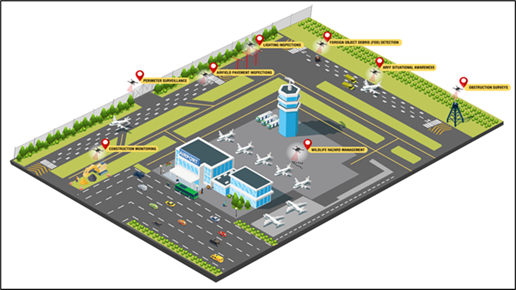
- Pavement inspections
- Wildlife hazard management
- Foreign Object Debris (FOD)
- ARFF situational awareness
- Obstruction surveys
- Lighting inspections
- Perimeter surveillance
- Construction monitoring
Several of these capabilities are no longer theoretical—they are operational today.
Pavement Inspections Without Runway Closures
Runway pavement is one of an airport’s most valuable and expensive assets. In 1998, the GAO highlighted the high cost, inconsistency, and safety risks of traditional pavement inspection methods. This led to the FAA’s push for 100% detailed inspections and standardized Pavement Condition Index (PCI) evaluations under ASTM D5340.
Traditional vehicle- and foot-based inspections:
- Require runway closures
- Place personnel in active movement areas
- Produce inconsistent, non-repeatable results
- Are labor-intensive and costly
By contrast, FAA-approved drone-based inspections, combined with AI analysis and engineer review:

- Meet all FAA safety, legal, and fiduciary requirements
- Eliminate runway closures
- Produce repeatable, auditable data
- Reduce inspection costs dramatically
- Support long-term maintenance planning and grant compliance
This is not just safer—it is better asset management.
Wildlife Hazard Management: Solving Hidden Problems
Bird strikes are a well-known risk, but fewer airport leaders realize what attracts birds to runways in the first place. One surprising culprit: anthills.
Ant colonies can:
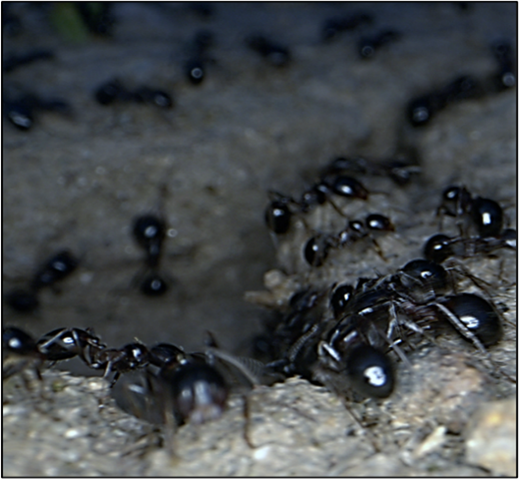
- Attract birds searching for food
- Erode subsurface materials under runways, taxiways, and aprons
- Increase long-term maintenance costs
- Create safety hazards that are difficult to detect visually
High-resolution 3D drone data allows airport operators to identify and mitigate these issues early, reducing wildlife risk while lowering long-term repair costs—something traditional inspections simply cannot do at scale.
FOD: Identifying the Source, Not Just the Debris
The FAA has determined that most FOD originates from pavement distress. Cracking, raveling, and joint failures generate debris that damages tires, engines, and aircraft structures.
Once an airport is digitized using FAA-approved cameras:
- A baseline 3D model identifies where FOD is being generated
- AI analysis correlates pavement distress with daily operations
- Airport staff can proactively address high-risk areas
- Damage is mitigated before costly incidents occur
This shifts FOD management from reaction to prevention.
Obstruction Surveys Made Simple
Drone-based surveys using FAA-specified cameras generate precise 3D point clouds of pavement and surrounding features, making it easy to identify:
- Obstructions
- Vegetation encroachments
- Objects in the OFZ, RSA, and imaginary surfaces
- Structures affecting Part 77 compliance
What once required multiple surveys and consultants can now be done through a single, repeatable digital process.

One Digitization, Many Uses
The real power of drone-based inspections is reusable data.
FAA guidance typically considers data valid for six months, with a preference for leaf-on and leaf-off conditions. In practice, drones are now so efficient—and AI processing so fast—that they are becoming part of daily airport operations, supporting:
- Part 139 inspections
- ARFF response planning
- Perimeter security
- Construction monitoring
- Asset management systems
One digital twin replaces dozens of redundant inspections.
AIP Grant Eligible and Easy to Implement
Yes—UAS inspections are AIP-eligible.
The FAA’s Airport Data Information Portal (ADIP) makes grant requests straightforward. Using simple dropdown menus and short narratives, applications can be submitted electronically and routed to the appropriate FAA authority quickly.
No friction. No guesswork.
Sustainability, Safety, and Fiscal Responsibility
Runways, roadways, and rail systems endure extreme loads and environmental stress. Rehabilitation is inevitable—but unnecessary rehabilitation is wasteful and avoidable.
Inaccurate inspections lead to:
- Premature demolition
- Excess material production
- Increased air pollution
- Unnecessary environmental impact
Silent Falcon’s inspection and analytics are precise enough to determine:
- Exact material quantities
- Targeted repair locations
- Optimal maintenance timing
This reduces waste, lowers emissions, protects wildlife, and saves public funds—all while improving safety.
Always Open, Always Safe
Silent Falcon inspections do not disrupt operations. Airports remain fully functional while leaders receive:
- Accurate PCI ratings
- Georeferenced, auditable data
- Predictive maintenance insights
- Defensible FAA compliance documentation
Our PavPrint™ technology creates an AI-powered digital fingerprint of your airfield, combining:
- High-fidelity digital twins
- Proprietary AI analysis
- Forward-looking maintenance forecasting
One inspection. Endless insight.
Data Access, Anytime
Silent Falcon is developing an iOS application (launching Spring/Summer) that will allow airport leaders to access infrastructure data 24/7—on an iPhone, iPad, or iPod Touch.
This is not about drones.
It’s about better decisions, safer operations, and stronger airport economics.
Airports are too valuable to manage any other way.