The Federal Aviation Administration (FAA) today released new design guidelines for vertiports, infrastructure that will support Advanced Air Mobility (AAM) aircraft. The design standards will serve as the initial step to provide key information for airport owners, operators and infrastructure developers to begin development of facilities that will support operations of AAM aircraft that are electrically powered and take-off and land vertically.
“Our country is stepping into a new era of aviation. These vertiport design standards provide the foundation needed to begin safely building infrastructure in this new era.” said Associate Administrator for Airports Shannetta Griffin, P.E.
These Vertical Takeoff and Landing (VTOL) operations will transport passengers or cargo at lower altitudes in rural, urban and suburban areas.
The design standards include critical information that designers and builders will need to follow to allow for safe takeoffs and landings. Some of those include:
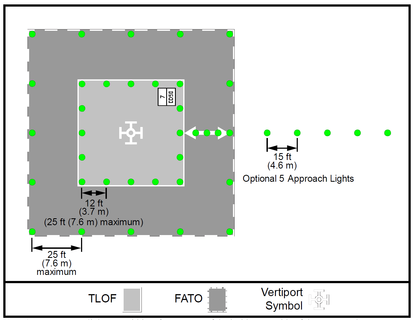
Safety-critical geometry and design elements: Dimensions for vertiport touchdown and liftoff areas, additional airspace needed for approach and departure paths and load-bearing capacity. In the future FAA anticipates a high rate of operations at many vertiports.
Lighting, markings and visual aids: Guidelines on markings, lighting and visual aids that identify the facility as a vertiport. The FAA recommends the Vertiport Identification Symbol, as shown in the middle of the graphic below.
Charging and electric infrastructure: Initial safety standards and guidelines for batteries and charging equipment that will be central to vertiports.
On-airport vertiports: Requirements for airports looking to add vertiports to an existing commercial airport, including the distance a vertiport would have to be from a current runway.
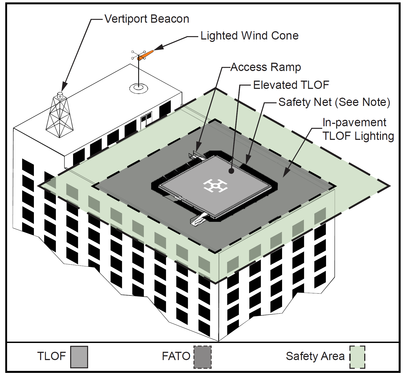
Elevated vertiports: Requirements and guidelines for vertiports that may be on top of existing structures.
This vertiport guidance will be used until performance-based vertiport design guidance is developed.
The final design standards are based on research conducted by the FAA, collaboration with industry partners and feedback from the public. The FAA held a virtual Industry Day on March 29, 2022, to discuss the draft standards it released in early 2022.