Descent procedures that the U.S. Department of Transportation’s Federal Aviation Administration (FAA) put in place across the country in the 2021 will save millions of gallons of fuel and reduce CO2 and other emissions by hundreds of thousands of tons. The 42 new Optimized Profile Descents (OPDs) allow planes to glide down safely from cruising altitudes into airspace for some of the nation’s largest airports instead of the fuel-consuming stair-step procedure.
“These new efficient descent procedures both save fuel and dramatically reduce emissions, moving us closer to our goal of net-zero aviation emissions by 2050,” U.S. Transportation Secretary Pete Buttigieg said.Â
For each group of descents used at an airport, the FAA estimates that an average 2 million gallons of fuel is saved and 40 million pounds of emissions reduced annually. That is equivalent to eliminating the fuel and CO2 emissions of 1,300 Boeing 737 flights from Atlanta to Dallas.
“When we multiply the impact by thousands of flights, we gain real fuel savings and real environmental benefits,” FAA Administrator Steve Dickson said.
In 2021, the FAA implemented OPDs for Dallas-Ft. Worth International Airport, Ft. Lauderdale-Hollywood International Airport, Harry Reid International Airport in Las Vegas, Lakehurst Maxfield Field in New Jersey, Love Field in Dallas, Miami International Airport, North Las Vegas Airport, Orlando International Airport, Port Columbus International Airport, Portland International Jetport, Tampa International Airport and numerous mid-size airports.
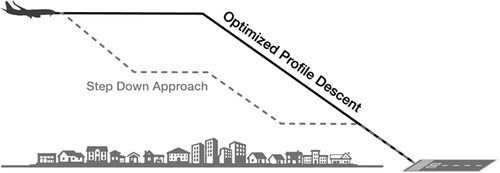
Under traditional staircase descent procedures, aircraft repeatedly level off
and power up the engines. This burns more fuel and requires air traffic
controllers to issue instructions at each step. With optimized descents,
aircraft descend from cruising altitude to the runway in a smooth, continuous
path with the engines set at near idle.
Since 2014, the FAA also has developed OPD procedures at airports in Atlanta, Charlotte, Cleveland, Denver, Detroit, Houston, Northern California, Southern California and Washington, D.C. More OPD procedures will be added in 2022.
The FAA employs a growing number of new flight procedures that use less fuel and reduce noise. These include NextGen initiatives such as Performance-Based Navigation (PBN). These procedures bring more precision to routes and result in less fuel burn and reductions in CO2 greenhouse gas emissions.
In November, the U.S. released its first-ever comprehensive Aviation Climate Action Plan to achieve net-zero emissions by 2050. Earlier in 2021, the FAA announced more than $100 million in matching grants to increase aircraft efficiency, reduce noise and aircraft emissions, and develop and implement new software to reduce taxi delays. The White House also announced its Sustainable Aviation Fuel Grand Challenge, a government-wide initiative designed to catalyze the production of at least three billion gallons per year by 2030.
Find more information about the FAA and its environmental efforts at its Sustainability Gateway Page.