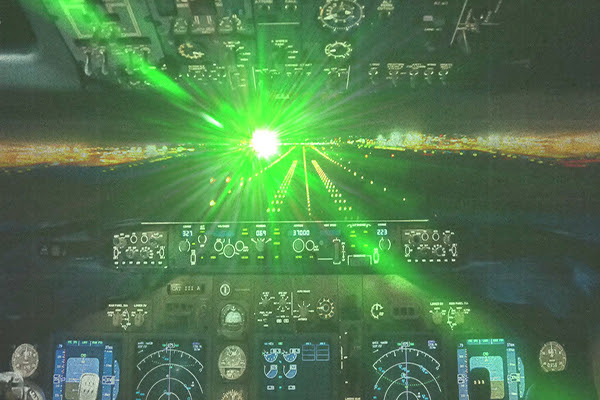
Shining a laser at an aircraft is a serious safety threat that continues to rise. As of Oct. 14, the Federal Aviation Administration (FAA) has received 7,186 laser strike reports for 2021, exceeding the 2020 total of 6,852. This marks the highest number or reports since 2016.
Many types of high-powered lasers can completely incapacitate pilots, many of whom are flying airplanes with hundreds of passengers. People who shine lasers at aircraft face FAA fines of up to $11,000 per violation and up to $30,800 for multiple laser incidents. The FAA has issued $120,000 in fines for laser strikes during 2021. Violators can also face criminal penalties from federal, state and local law enforcement agencies.
“Pointing a laser at an aircraft can temporarily blind a pilot and not only affects the crew, but also endangers passengers,” said FAA Administrator Steve Dickson.
To identify laser strike trends, the FAA developed a visualization tool, using the Tableau software platform that shows laser strike data from 2010 to 2020 and highlights trends by geographic area, per capita data, time of day and year. The FAA shares the information to draw attention to the dangerously high rate of laser strikes on airplanes. Laser report data by year can be downloaded on the FAA’s website.
The FAA remains vigilant to raise awareness about the dangers of pointing lasers at aircraft and encourages the public to report laser strikes to the FAA and local law enforcement agencies.