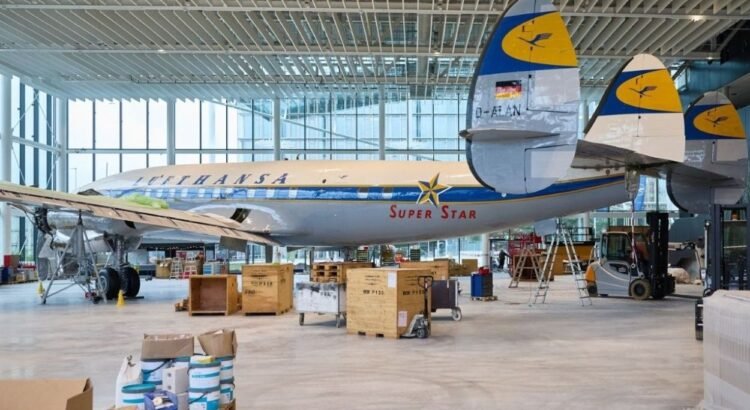
The next important milestone has been reached at Lufthansa Group Hangar One, the new conference and visitor center currently under construction at Frankfurt Airport: the tail unit has now been mounted on the Lockheed L-1649A Super Star. The three-part rudder is characteristic of this particular aircraft series. It has a wingspan of over 15 meters and weighs around 1.4 tons. The assembly was carried out using two forklifts operating in parallel.
With this, all the large components of the Super Star have now been successfully assembled. The historic aircraft, once a symbol of innovation and elegance, was painted this summer at Münster/Osnabrück Airport in its classic 1950s livery. The fuselage, wings, engines, and tail were then transported to Frankfurt by heavy haulage. The various aircraft parts were assembled in the new building at Frankfurt Airport over the past few weeks. Now, with a total length of around 35 meters and an impressive wingspan of more than 45 meters, the Super Star shines again in all its former glory.
Together with the legendary Junkers Ju 52, the Lockheed Super Star will be the main attraction of the “Lufthansa Group Hangar One.” Due to a glass facade, visitors can also admire the two icons of aviation history from the outside. The opening of the conference and visitor center coincides with the 100th anniversary of the founding of the first Deutsche Luft Hansa and underscores the importance of aviation history for the Lufthansa Group.