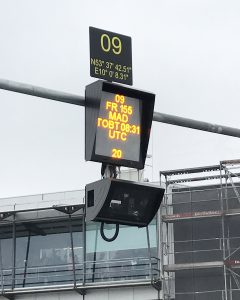
 ADB SAFEGATE has successfully delivered four Safedock T1 Advanced Visual Docking Guidance Systems (A-VDGS) and a SafeControl Apron Management (SAM) System to Hamburg Airport, Germany’s oldest and the fifth busiest airport. Originally built in 1911, the airport handled 16,223,968 passengers and 160,904 flights in 2016.
Previously, Hamburg Airport has worked with ADB SAFEGATE to install airfield lighting solutions. As part of its recent WiWo (walk-in walk-out) gate project, the airport dismantled its existing boarding bridges and built four new walk-in and walk-out gates for its low-cost carriers. Passengers now board and disembark aircraft directly via the apron through staircases at the front and back of the aircraft, saving valuable turnaround time. The installation of the Safedock A-VDGS and SAM will ensure safety and improve efficiency at the new gates by providing highly accurate time stamps and object scanning.
Hamburg Airport was looking for a solution that would support A-CDM on the apron. ADB SAFEGATE has integrated the A-VDGS and SAM solution with the airport’s new IT system, HAM SuITe, which is the foundation for A-CDM at Hamburg Airport. The new apron solution collects and shares flight and turnaround milestones in real-time with all stakeholders to streamline operations. Real-time insight means better use of resources and infrastructure, shortening turn times, increasing capacity and improving revenue for the airlines and the airport.
The airport also wanted laser-based A-VDGS which are fully ICAO compliant and meet the strict European standard EN 50512. ADB SAFEGATE’s Safedock systems with 3D laser scan technology are fully compliant.
“Our solutions are one of the key parts of Hamburg Airport’s A-CDM program for the apron, supporting shorter turnaround times at the WiWo positions and increasing safety at the gate,” said Judith Kruse, area sales manager, ADB SAFEGATE.