The aviation innovation and technology of the Korean War era, which in this year marks 75 years since its beginning, will be highlighted at EAA AirVenture Oshkosh 2025. The 72nd edition of the Experimental Aircraft Association’s fly-in convention will be held at Wittman Regional Airport in Oshkosh, Wisconsin.
The aircraft on display will showcase the transition from piston-powered aircraft to fighter jets and will be included in air show demonstrations and on display in Boeing Plaza and in the Warbirds area.
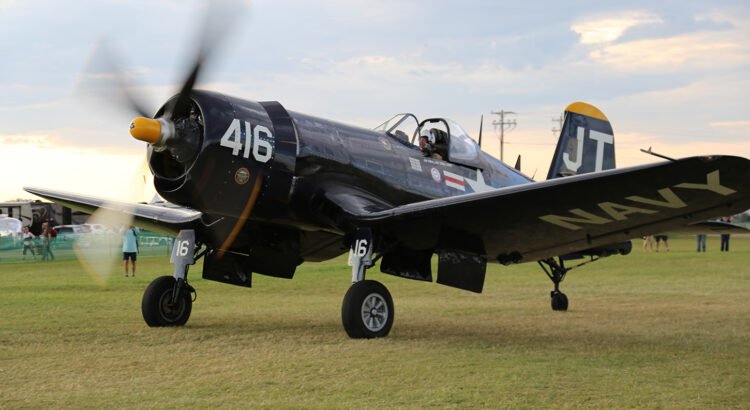
“While legendary World War II aircraft such as the Corsair and P-51 Mustang still were widely flown at the start of the Korean War in 1950, a new age of jets rapidly came to the front lines during that time,” said Rick Larsen, EAA’s vice president of communities and member programs, who coordinates AirVenture features and attractions. “It marked a permanent change in aviation technology that will be prominent at Oshkosh this year.”

Among the Korean War-era piston-powered aircraft committed are the Corsair, P-51 Mustang, B-29 Superfortress, AD-4 and AD-5W Skyraiders, PB4Y, and L-5. Jet aircraft committed to AirVenture include the P-80, F-84, MiG 15, MiG 17, and F-86 Sabre. This year also marks the 85th anniversary of the Corsair, the 80th anniversary of the A-1 Skyraider, and the 75th anniversary of the MiG 17.
While elements of these displays will be present throughout AirVenture week, a primary focus will be Wednesday through Friday, July 23-25, that will include air show performances by a variety of these aircraft. In addition, evening programming at EAA’s Theater in the Woods and Fly-In Theater are in development that will correspond to the commemoration of the Korean War’s 75th anniversary. More details on those programs will be announced as they are finalized.