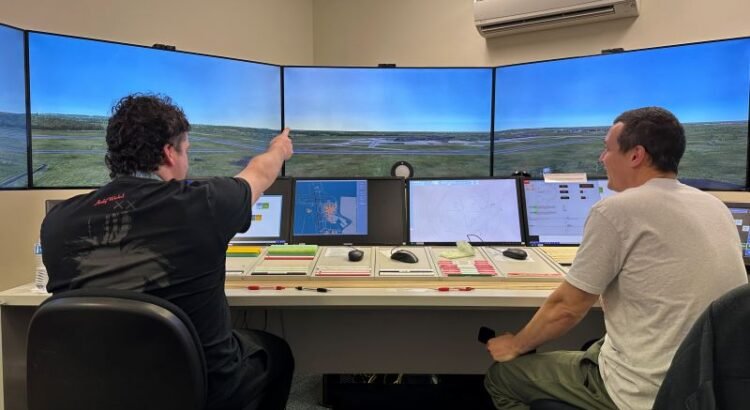
Photo – Air Traffic Control students use the Adacel MaxSim™ simulator to train in Perth.
Adacel Technologies Limited has announced the successful implementation of a remote pseudo-pilot trial with Airservices Australia, enabling Air Traffic Control (ATC) training to be delivered across sites in Melbourne and Perth without the need to relocate staff.
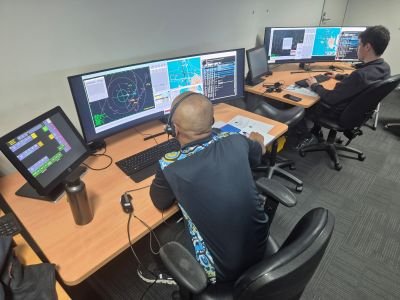
As part of the Airservices Australia Tower Ab-Initio course, four students commenced training in May 2025 utilizing the Adacel MaxSim™ Tower Simulator installed in Perth. Traditionally, pseudo-pilot staff, who provide critical simulation support during controller training, have been co-located with ab-initio trainees. However, Airservices Australia sought a solution to leverage its simulator facility in Perth while drawing on the expertise of its pseudo-pilot team in Melbourne.

In response, Adacel has integrated its MaxSim™ simulation system with a secure remote link, connecting pseudo-pilot positions in Melbourne directly to the tower simulator in Perth. The innovation trial has allowed Airservices to assess the feasibility of using this technology to deliver future tower training courses with a remote pseudo-pilot capability. Marcus Knauer, head of Airservices Workforce Resilience, says, “The introduction of such technologies would allow Airservices to manage the logistical and financial challenges of relocating staff to attend training, while maintaining the highest standards of training delivery.”
The course will run until March 2026 and represents a significant milestone in the use of distributed training environments for ATC in Australia.
“We are delighted to partner with Airservices Australia on this important initiative.” Said Michael Saunders, Vice President of Adacel. “By enabling remote simulator operations, we are helping to create greater flexibility and resilience in the training pipeline while ensuring that students receive the same high-quality learning outcomes.”
This trial builds on a growing body of work within the global Air Traffic Management industry to explore remote training technologies, ensuring the next generation of controllers can be trained efficiently and effectively, regardless of location.