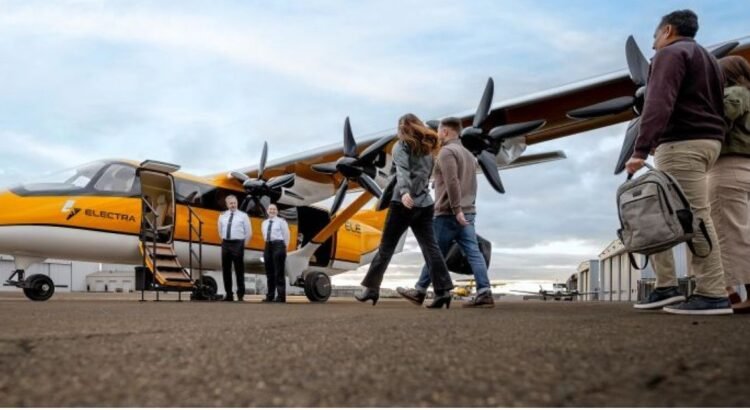
Electra and VertiPorts by Atlantic, a wholly owned subsidiary of Atlantic Aviation, announced a Memorandum of Understanding (MOU) to assess infrastructure opportunities that could bring Ultra Short aircraft operations closer to where people live and work.
The two companies will explore how different forms of infrastructure, like barges, piers, or elevated surfaces, could unlock Ultra Short operations at new and existing VertiPorts by Atlantic sites in New York City. This marks the first step in a broader collaboration to identify opportunities for Ultra Short access points across multiple regions.
The initiative comes on the heels of Electra’s successful demonstration at Downtown Skyport [video] in Lower Manhattan, marking what is believed to be the first time a fixed-wing aircraft without vertical takeoff capability has landed at the heliport. Electra is advancing Direct Aviation, a new model of point-to-point regional travel that complements the existing hub-and-spoke system with distributed access points closer to where journeys begin and end.
Electra’s inaugural Direct Aviation Market Outlook, a nationwide analysis of nearly one billion trips, identified 35 million passenger trips each day across distances of 50 to 500 miles. The outlook estimates potential time savings of approximately 3 hours and 45 minutes from New York City to Boston, 3 hours and 30 minutes to Washington, D.C., and 45 minutes to Philadelphia.

“The demand already exists for regional travel that is faster and more convenient, and Direct Aviation is about meeting that demand,” said Diana Siegel, Vice President, Commercial Programs at Electra. “By assessing how new and existing VertiPorts by Atlantic sites could accommodate the EL9 Ultra Short, we are taking a step toward connecting New York City with communities across the region and showing what Direct Aviation has to offer.”
“Electra’s ability to operate from dramatically smaller footprints presents exciting opportunities to reimagine how regional air transportation connects with urban environments,” said Kevin Cox, CEO of VertiPorts by Atlantic. “Together, we’re assessing how existing and emerging infrastructure can support a new generation of aircraft and provide travelers with faster, more convenient connections throughout the Northeast and beyond.”
Unlocking Direct Aviation
Electra is building the aircraft and ecosystem needed to move Direct Aviation from concept to reality at commercial scale. Electra’s EL9 Ultra Short is a nine-passenger hybrid-electric aircraft designed to take off and land in as little as 150 feet. The EL9 does this while meeting the Rule of Six, or the essential requirements needed to make Advanced Air Mobility practical at scale: quiet operations, expanded access, uncompromising safety, meaningful payload, practical range, and affordability. By delivering helicopter-like access with the safety benefits of fixed-wing flight, Electra is making regional air travel safer, quieter, and more accessible to people and communities.
Electra’s Direct Aviation Market Outlook projects that this new category of regional air service could carry one million passengers per day within its first decade of operations. Serving that demand will require an estimated 12,000 to 16,000 aircraft, supported by distributed access points, regional operators, regulatory frameworks, and a scaled aviation supply chain.
Electra recently selected Springfield, Ohio, as the site of its first EL9 production facility. The planned $850 million development is expected to create nearly 2,000 jobs and ultimately support production of up to 800 aircraft annually, providing the industrial foundation to bring Direct Aviation to communities across the United States and beyond.